FOR IMMEDIATE RELEASE
June 20, 2026
New Biblical Theory Maps Revelation’s Tribulation to Modern Catastrophes: Limited Nuclear War, Rogue Planet, and Global Upheaval
Robert Macs Art LLC Formulates Detailed Interpretation Linking Four Horsemen, Asteroid Impacts, and Prophetic Invasions to Scripture
Robert Macs Art LLC today announced the formulation of a comprehensive theory of the Tribulation, developed through careful study of the Book of Revelation and related passages in the Old Testament. This cohesive narrative identifies specific, plausible modern and near-future events as the fulfillment of the apocalyptic symbols, providing both a timeline and causal framework for the prophesied sequence of global catastrophe. At the heart of the theory lies the identification of a limited nuclear war as the triggering event for the Four Horsemen of the Apocalypse (Revelation 6). This conflict is described as producing a 25 percent global mortality rate, unleashing the riders of Conquest, War, Famine, and Death on an unprecedented scale.
Exactly two years and five months after the war begins, the theory predicts mass population movements originating from Eastern Europe and Russia will attempt to invade Israel, aligning with longstanding prophetic expectations of end-times conflict centered on the Holy Land.
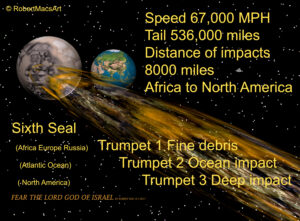
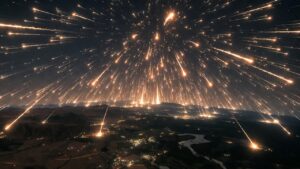
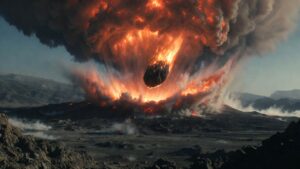
Subsequent events involve a planet with a debris tail whose gravitational influence causes the Earth to “reel back and forth,” triggering a planet-wide earthquake. The debris tail generates a devastating “wall of fire” consisting of meteorites 1 to 3 feet in diameter, which the theory indicates will ignite widespread fires across Africa and Europe.
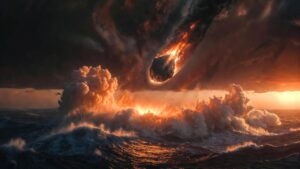
A large asteroid within the tail is projected to impact and effectively devastate the Atlantic Ocean through massive displacement and tsunamis. Another deep impact strikes North America, releasing enormous quantities of ash that destroy fresh water supplies across the continent. This same event is associated with the release of stinging insects that torment the populations of the Americas for a period of five months, corresponding to the fifth trumpet judgment in Revelation 9. Finally, the theory connects the widespread nuclear fallout from the initial conflict to the mobilization of an army of 200 million men from China, who invade neighboring nations in a struggle for survival amid the breakdown of global infrastructure and resources.
“Through prayerful examination of Scripture and correlation with real-world scientific and geopolitical realities, we have formulated this unified story of the Tribulation. It is our prayer that this work equips the Church to understand the times and point people to the hope found in Jesus Christ.”
— Robert Macs, Robert Macs Art LLC
Complete details of the theory, along with original artwork, in-depth Bible studies, commentary, meditation music, and visual teaching resources, are freely available at TheRevelationStory.com and RobertMacsRevelation.com.
About Robert Macs Art LLC
Robert Macs Art LLC is dedicated to creating sound and visual Bible study tools focused on the Book of Revelation. The organization provides free printable artwork, music, videos, and written commentary for non-commercial use by churches, pastors, Bible study groups, and individual Christians worldwide. All materials are offered to aid in teaching biblical prophecy and sharing the gospel of Jesus Christ. Resources may be shared freely in church settings, online witness, or personal study with proper attribution to Robert Macs Art LLC.
Media & Ministry Inquiries:
TheRevelationStory.com | RobertMacsRevelation.com | RobertMacsArt.com
YouTube & Facebook: @RobertMacsMedia
These events are impossible without God/Jesus causing this to happen.
Nuclear War
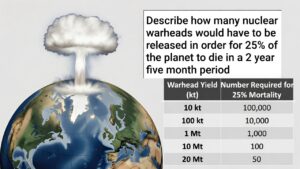
Revelation 6. Describe how many nuclear warheads would have to be released in order for 25% of the planet to die in a 2 year five month period
Roughly 100–500 modern nuclear warheads (or fewer in a worst-case targeting scenario), particularly if detonated over cities, could plausibly lead to ~2 billion deaths (about 25% of the current ~8 billion world population) within ~2–3 years, primarily through indirect effects like nuclear famine rather than immediate blasts.
This estimate draws from peer-reviewed climate and crop models (e.g., studies in Nature Food and work by researchers like those at Rutgers, led by Alan Robock and Lili Xia). Exact numbers are highly uncertain and depend on variables like warhead yields, targets (cities vs. military), detonation heights, weather, and post-war societal responses. These are not precise predictions but modeled scenarios.
Breakdown of Effects and Timeline
Immediate/Short-Term Deaths (Days to Weeks): Blast, heat, firestorms, and initial radiation.
A single large warhead on a city can kill hundreds of thousands to millions directly.
Regional exchange (e.g., ~100 weapons, India-Pakistan style, many 15–100 kt yields on urban areas): ~20–50+ million direct deaths.
Larger exchanges scale this up dramatically (hundreds of millions possible in a U.S.-Russia scenario with thousands of warheads).
Nuclear Winter/Famine (Months to Years): Soot from firestorms injected into the stratosphere blocks sunlight, causing global cooling (1–several °C or more), reduced precipitation, and crop failures. This is the dominant killer for the 25% threshold.
~100 weapons (small fraction of global arsenals): Can inject enough soot (tens of Tg) for significant cooling. Models project 1–2+ billion at risk of starvation within 2 years due to ~20–50%+ drops in global calorie production. Famine deaths could reach or exceed 25% of the population, especially in import-dependent or mid/high-latitude regions (e.g., severe impacts in China, India, parts of Africa/Europe).
Timeline fits: Crop failures peak in the first 1–2 growing seasons; famine and related disease/conflict intensify over 2–3 years. Models often cite ~2 years for major famine tolls.
A full-scale U.S.-Russia exchange (thousands of warheads) would far exceed this, with direct deaths in the hundreds of millions and total famine deaths potentially 5+ billion (over 60% of humanity).
Key Factors Influencing the Number
Yields and Targeting: Higher-yield or city-targeted weapons produce more soot/firestorms. Smaller/tactical weapons cause less global climate impact but still massive local harm.
Number of Warheads: Global stockpiles total ~12,000+, but only a small percentage (under 5%, or hundreds) is needed for catastrophic global effects via climate disruption. Not all need to detonate successfully.
Other Multipliers: Ozone depletion (increased UV), radiation fallout, societal collapse, disease, and conflict over resources would accelerate deaths. Livestock/fisheries also collapse.
Mitigation Limits: Trade cessation, hoarding, and failed adaptation mean even “optimal” distribution can’t prevent massive famine in models.
Important Caveats: These are scientific models with uncertainties (e.g., exact soot amounts, recovery times, human adaptability). Real outcomes could vary. Nuclear war of any scale is catastrophic and unpredictable, with no “winners.” Direct effects alone rarely reach 25% quickly without the famine multiplier, which aligns with the 2-year-5-month window.
This scenario underscores why even “limited” nuclear use is considered globally destabilizing. For deeper reading, refer to IPPNW’s Nuclear Famine reports or Xia et al. (2022) studies.
Israel Invasion stopped by Sixth seal and Trumpet 1
Cause of Gog and Magog mass migration to Israel (Eastern Europe and Russia) Ezekiel 38-39
Significant nuclear damage to Eastern Europe and Russia—on the scale of dozens to hundreds of warheads targeted at population centers, military sites, and infrastructure—could render large parts of the region effectively uninhabitable or unlivable for years to decades, triggering mass outward migration for survival.
This would stem from a combination of direct destruction, radioactive fallout, and nuclear winter effects, far beyond what local populations could endure. Migration would likely involve millions fleeing south or to less-affected areas, though global conditions would limit safe havens.
Scale of Damage Required for Mass Migration
Limited/Regional Exchange (e.g., dozens to ~100 warheads, many on or near Eastern Europe/Russia/Ukraine border):
Direct blast/fire/radiation could destroy major cities (e.g., Kiev, Minsk, Warsaw, parts of western Russia) and kill tens of millions immediately.
Fallout plumes would contaminate vast areas downwind (prevailing winds often carry it across Europe/Russia). Models suggest even a border conflict could spread radioactive material widely, with lethal or debilitating doses over large zones.
Nuclear winter cooling (several degrees globally, worse in mid/high latitudes) would cause crop failures, freezing conditions, and famine. Russia and northern/eastern Europe would be hit especially hard—agriculture largely impossible for years, with starvation rates potentially exceeding 75–99% in worst models without aid.
Larger Exchange (hundreds to thousands of warheads, as in NATO-Russia scenarios):
Much of European Russia, Ukraine, Belarus, and Eastern Europe could see overlapping fallout, destroyed infrastructure, and firestorms.
Cities and industrial areas turned to ruins; radiation making resettlement hazardous for years/decades in hotspots.
Severe nuclear winter: Temperatures dropping enough for permafrost-like conditions in growing seasons across northern latitudes. Food production collapses regionally, with Russia facing massive calorie deficits.
Threshold for Migration: When local food/water becomes scarce or contaminated, radiation doses remain high (hundreds of rads), infrastructure (power, hospitals, transport) collapses, and winter-like conditions persist. This could happen within months, forcing survivors to flee. Historical analogies (e.g., Chernobyl exclusion zones) show long-term uninhabitability in contaminated areas; scaled up, entire regions could be affected.
Why Migration Would Be Massive and Difficult
Uninhabitable Factors: High radiation (acute sickness/death, long-term cancer), contaminated soil/water/food, collapsed agriculture, disease outbreaks, and societal breakdown. Northern latitudes (much of Russia/Eastern Europe) suffer worst from cooling/drying.
Numbers: Tens to hundreds of millions displaced regionally. Russia alone could see massive internal and outward flight; Eastern Europe similar. Global famine would strain receiving areas.
Challenges: Borders overwhelmed, other regions also suffering famine/climate effects, radiation spread, and conflict. Safe migration southward (e.g., toward Mediterranean or Asia) would be chaotic.
Even a “small” conflict involving nuclear use in this region could escalate effects globally via climate and fallout, making survival migration a desperate, high-mortality endeavor. These outcomes are modeled projections—real events would be unpredictable and catastrophic
It depends on mass and distance, not physical diameter alone.
A rough gravitational-tide estimate:
Body size/mass
Distance where effects could become severe
Mars-sized
~300,000–700,000 km
Earth-sized
~800,000–1,500,000 km
Neptune-sized
~3–6 million km
Jupiter-sized
~8–15 million km
But here is the key point: plate tectonics are already moving. They do not need a passing planet to “begin.” They are driven mainly by Earth’s internal heat and mantle convection.
For a passing planet to make Earth noticeably wobble, distort the atmosphere, and strongly stress the crust, it would need to produce tides much stronger than the Moon’s. At that point, it would also likely cause:
enormous ocean tides
severe crustal deformation
disruption of the Moon’s orbit
visible changes in the sky
possible destabilization of Earth’s orbit
So the most reasonable estimate is:
An Earth-sized planet within about 1 million km could cause serious tidal stress, but it would be obvious and catastrophic. A Jupiter-sized body could do similar damage from around 10 million km away, but it would gravely disturb Earth’s orbit.
Trumpet 1
Size of Meteoroid That Can Ignite Grass and Trees
A meteoroid that can cause a fire in grass or trees is generally in the range of about 10–100 cm (4–40 in) in diameter.
Why this size range works
Small meteoroids (1–10 cm) often burn up completely in the atmosphere, producing bright meteors or “fireballs” but rarely reaching the ground www.astronomy.me.uk.
Medium meteoroids (10 cm–1 m) can survive atmospheric entry as bolides, producing intense heat and light, and may land as meteorites www.astronomy.me.uk+1.
At ~10–100 cm, the object is large enough to carry enough mass to ignite vegetation, but small enough to still burn up partially or partially survive to the surface.
The heat from such an object can reach several hundred degrees Celsius, enough to ignite dry grass, leaves, or other flammable material HowStuffWorks.
Larger meteoroids (1 m+) are more likely to cause destructive impacts, but even smaller ones in this range can cause localized fires if they land in dry vegetation.
Energy and ignition
The kinetic energy of a 10 cm meteoroid entering at ~11 km/s is enough to vaporize its surface and produce a fireball visible from the ground HowStuffWorks.
If it lands in a dry area, the heat and debris can ignite grass or trees, especially if the object is metallic or rocky and conducts heat well.
Smaller dust-sized particles (micrometeoroids) do not carry enough energy to cause fires, while larger objects (>1 m) are more likely to cause widespread destruction.
In summary: For grass or tree ignition, a meteoroid in the 10–100 cm diameter range is most likely, with the exact size depending on composition, entry angle, and local vegetation conditions
Trumpet 2
Asteroid Size Needed to Survive the Atmosphere and Destroy the Atlantic Ocean
To cause catastrophic destruction of the Atlantic Ocean, an asteroid would need to be large enough to survive atmospheric entry, generate a massive shockwave, and trigger a tsunami of unprecedented scale.
Key size thresholds from NASA and impact studies
< 25 m: Most likely to burn up in the atmosphere, causing little damage NASA.
25 m – 1 km: Can cause local devastation; larger than 1 km can have worldwide effects NASA.
1–2 km: Capable of global climate disruption and mass extinction-level effects NASA.
5–6 km: Chicxulub-class impactor; 66 million years ago, a 10–12 km asteroid hit the Yucatán Peninsula, creating tsunamis that reached the Atlantic coast and caused global climate collapse James Webb Discovery+1.
Atlantic Ocean destruction scenario
For the Atlantic Ocean to be “destroyed” in the sense of being inundated to the continental shelf or causing catastrophic coastal flooding, the asteroid would need to be at least several kilometers in diameter.
3–5 km: Could produce tsunamis hundreds of meters high, capable of sweeping across the continental shelf and inundating the U.S. East Coast and beyond University News & Events.
6–10 km: Chicxulub-scale impacts have been linked to tsunamis reaching the Atlantic coast and altering ocean circulation The Planetary Society.
10–12 km: As in the Chicxulub event, would generate multi-hundred-meter tsunamis, global climate effects, and mass extinction James Webb Discovery+1.
Example from simulations
A 1950 DA asteroid, about 0.8 km (0.5 mile) in diameter, is predicted to hit the Atlantic Ocean in 2880, producing tsunamis up to 400 ft (120 m) high along the U.S. East Coast University News & Events. While this is not “destroying” the ocean in a geological sense, it would be a civilization-threatening event.
Conclusion
To truly “destroy” the Atlantic Ocean in a catastrophic, long-term sense (e.g., massive tsunamis, ecosystem collapse, climate change), an asteroid would need to be at least 5–10 km across, with 10–12 km being in the range of the Chicxulub impact that ended the dinosaurs James Webb Discovery+2. Smaller impacts (3–5 km) could still cause devastating tsunamis and regional devastation, but the global ocean-scale effects would be most severe for the larger end of that range.
Trumpet 3
Asteroid Size Needed to Trigger a Yellowstone Caldera Explosion
If an asteroid were to strike the Yellowstone super volcano, the size required to trigger a full-scale caldera eruption would be in the hundreds of kilometers in diameter — comparable to the asteroid that caused the extinction of the dinosaurs.
Key size thresholds:
~50 miles (80 km) diameter: This is the scale of the Chicxulub impactor that ended the Cretaceous period. Such an asteroid would not just survive atmospheric entry; it would vaporize on impact, generate a global-scale blast wave, and inject massive amounts of dust and gases into the atmosphere. If it hit Yellowstone, it would likely trigger a massive eruption and cause a “nuclear winter”-like cooling effect worldwide International Business Times.
Kilometer-scale (1–10 km): These impacts would still be catastrophic, producing continent-scale devastation, tsunamis, and climate effects, but they are less likely to directly trigger a super volcano eruption unless the impact is very close to the magma chamber NASA Advanced Supercomputing Division Website.
Hundreds of kilometers: Only at this scale would the energy be sufficient to directly destabilize the Yellowstone magma chamber and cause a caldera-forming eruption on top of the impact effects International Business Times.
Why size matters:
Smaller asteroids (tens to hundreds of meters) may explode in the atmosphere (air bursts) like the 2013 Chelyabinsk meteor, causing regional damage but not triggering volcanism Wikipedia.
Larger impacts (>1 km) can generate shockwaves that travel through the crust, potentially fracturing the overlying rock dome and pressurizing the magma chamber Earth Science Stack Exchange.
The Chicxulub-scale impactor (~10 km) is the benchmark for “planet-killer” energy, and at that size, the combination of impact and volcanic eruption would be a global catastrophe International Business Times.
Bottom line:
To make it through the atmosphere and cause a Yellowstone caldera to explode, the asteroid would need to be at least several kilometers across, with the most extreme scenario being ~50 miles (80 km) or larger. At that scale, the impact would be so energetic that it would likely trigger the supervolcano’s eruption regardless of location, but the combined effects would be devastating on a planetary scale.
200 million man march
How many nuclear warheads would have to fall on China in order for 200 million men to leave and invade its neighbors for survival
Hundreds to low thousands of high-yield nuclear warheads, depending on targeting, yields, and follow-on effects — but realistically, far fewer might trigger total societal collapse and desperate mass migration, while more would just kill everyone outright.
Quick Demographics Context
China has ~1.41 billion people, with roughly 700+ million males total (about 717 million in recent estimates). 200 million men is roughly 28-30% of all males, or a huge chunk of military-age/working-age men (say, ages 18-45). This isn’t a small refugee flow — it’s an organized or chaotic horde-scale exodus on a level unseen in history.
What It Would Take to Cause That Scale of “Leave or Die”
To force 200 million men (plus families/supporters) to abandon China and invade neighbors (Russia, Central Asia, Vietnam, etc.) for survival, you’d need:
Widespread destruction of cities, industry, and infrastructure so the economy and governance collapse.
Agricultural and food system failure leading to famine for hundreds of millions.
Radiation, fallout, fires, and climate effects making large regions uninhabitable long-term.
Enough survivors motivated/coerced into migration rather than just dying in place.
Nuclear effects aren’t linear. A few dozen well-placed strikes on major cities could kill tens of millions immediately and cause chaos. But for this scale:
Direct blast/thermal/fire effects: China’s major population and industrial centers (e.g., Beijing, Shanghai, Guangzhou, Chongqing, Shenzhen, etc.) hold a huge fraction of people and economy. Striking the top 20-50 urban/industrial areas with 100-500 kt warheads could kill 100-300+ million outright and displace far more. Historical models for city destruction (e.g., WWII firebombing scaled up) show dense Chinese cities are very vulnerable.
Fallout and radiation: Ground bursts maximize this. Targeting eastern/coastal population belts would contaminate farmland and water.
Nuclear winter/famine: Even a “limited” regional nuclear war (e.g., India-Pakistan scale) could drop Chinese crop yields dramatically (rice -20-30%+, wheat much worse). A larger exchange involving China would cause global soot injection, cooling, and famine killing hundreds of millions more in China via starvation over 1-10 years. Models show China highly vulnerable due to reliance on intensive agriculture.
Realistic estimates from strategic literature suggest:
A few hundred modern warheads (MIRVed ICBMs/SLBMs) could devastate China’s urban core and military capacity.
To “destroy” a large country like China in terms of societal function: low hundreds to ~1,000-2,000, accounting for redundancy, hardened targets, and dispersal.
China’s own arsenal is ~600 warheads (growing), but this is about incoming strikes on it.
Rough Ballpark
~100-300 warheads: Massive casualties (50-200+ million dead), economic collapse, refugee waves — but probably not a coordinated 200M male invasion force. More like millions fleeing chaotically, with most survivors dying in place from famine/radiation.
500-1,500+: Plausible for the scenario. Enough to gut the eastern heartland (where most people live), destroy food production/logistics, and create “survive by conquering” incentives in less-hit western/inland areas. Nuclear winter would amplify this nationwide.
Many thousands: Overkill — most of the population dies from direct effects + fallout + years of famine. Little left to “invade” with.
Variables that matter hugely:
Yields and targeting: 100 kt-1 Mt weapons. Counterforce (military) vs. countervalue (cities). Air vs. ground bursts.
Delivery and defenses: Many would be intercepted; others wasted on empty silos.
Follow-on: EMP, infrastructure failure, no rescue, disease, internal warlordism.
Neighbors’ response: Invading radiation-scarred survivors into Russia, India, etc., would face conventional/nuclear resistance.
This is all speculative modeling — real nuclear war is unpredictable and far worse than calculations suggest due to cascading failures. No sane actor wants this; it’s mutually assured destruction territory. The scenario sounds like dark meme/fiction rather than feasible strategy. Historically, even total conventional devastation (e.g., WWII China) didn’t produce a 200M male invasion wave. Nuclear scale would be orders of magnitude deadlier.